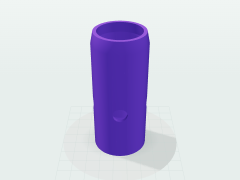
 Eductor nozzle, 1/2 in PVC return — Reef flow nozzle generator 3D print model
Design printable reef return nozzles: random-flow fins, eductor, flare or jet cones for Loc-Line or PVC pipe. Free 3MF & STL for PETG.
Features
- Four nozzle types: random-flow fins, eductor, flare and jet
- Loc-Line socket with three sandable retention nubs, and a ball-diameter field for hose you have measured
- Slip-on pipe collar 10-32 mm on the OD + 0.1 mm friction recipe, with grip ribs
- Presets for 1/2 in and 3/4 in Sch40 PVC and 19 mm all-in-one returns
- Fin rows, count, twist angle and depth all adjustable, from laminar to super turbulent
- Flow guidance panel: streamline sketch, estimated exit speed, spread and volume moved, plus pros, cons and best-fit notes for every tip
- Eductor motive diameter, intake windows and mixing tube length adjustable
- Readouts for exit-to-inlet area, print mass and total length
- Prints vertically with no supports; intake windows bridge like arches
What people make with it
- Turn a steady return jet into natural, chaotic surge like an RFG nozzle
- Amplify return flow 3-5x with an eductor that entrains tank water
- Spread a gentle wide current with a fan diffuser for SPS-light tanks
- Focus a long crossing current with a jet tip
- Fit any nozzle to 1/4, 1/2 or 3/4 in Loc-Line, Sch40 PVC or an AIO return spigot
How to use
- Pick the nozzle type for the flow you want.
- Choose the inlet: Loc-Line size or your pipe's outer diameter.
- Tune the internals: fins for random flow, or the motive jet and intakes for an eductor.
- Check the exit diameter against your return pump's flow.
- Download and print in PETG, inlet face down on the bed.
Materials
- PETG: recommended — Reef-safe, durable in warm saltwater.
- ASA: works — Reef-safe and UV-resistant.
- PLA: not suitable — Deforms and degrades in warm saltwater; fit-check only.
Presets
- Random flow nozzle, 1/2 in Loc-Line — Two counter-twisting fin rows break a steady 1/2 in Loc-Line return into random, wave-like flow.
- Stubby random nozzle, 1/2 in Loc-Line — Short random flow nozzle for 1/2 in Loc-Line returns in tight spaces behind the rockwork.
- Random flow nozzle, 3/4 in Loc-Line — Three fin rows turn a 3/4 in Loc-Line return into a wide, soft, chaotic surge.
- Eductor nozzle, 1/2 in PVC return — Flow-amplifying eductor that slips over a 21.3 mm 1/2 in Sch40 PVC return pipe.
- Eductor nozzle, 19 mm AIO return — Flow-amplifying eductor for all-in-one tanks with a 19 mm return spigot (IM Fusion and similar).
- Fan diffuser nozzle, 1/2 in Loc-Line — Wide, gentle fan of water from a 1/2 in Loc-Line return for soft coral and seahorse tanks.
- Jet nozzle, 3/4 in PVC return — Focused, far-reaching jet for long tanks, slipped over a 26.7 mm 3/4 in Sch40 PVC pipe.
Frequently asked questions
Which material is safe in a reef tank?
PETG or ASA. PLA deforms and degrades in warm saltwater; standard resin is not rated for continuous immersion.
Which nozzle type should I pick?
Random flow for a mixed reef that dislikes a steady blast; an eductor when the pump has head to spare and you want 2-4.5x the volume at gentle speed; a flare for the widest, softest spread with short reach; a jet for the longest, fastest lane - aimed at glass or rockwork, never straight at corals. The guidance panel on the tool page sketches each pattern and estimates speed, spread and volume from your pump rate.
The Loc-Line ball will not go into the socket. What do I do?
The socket mouth is a little wider than the ball, so the ball should drop in past the three nubs. If your printer runs tight, sand or cut the nubs down. If the ball is loose or far too tight, measure it with calipers and enter the value under Ball diameter - the nominal sizes are estimates, because Loc-Line does not publish them.
How tight should the pipe collar be?
The bore is 0.1 mm over the pipe OD: a firm friction fit. Wet the pipe before sliding it on, and scale the print about 1 % larger if it is still too tight.
Will it restrict my return pump?
Random-flow fins and a narrow motive jet add some head loss. Watch the exit-to-inlet readout and prefer fewer fins or a wider jet if flow drops too much. The flow figures in the guidance panel are rough estimates, not measurements.
How does the eductor amplify flow?
The narrow motive jet speeds the water up, dropping its pressure; that pulls tank water in through the side windows, so the mixed outlet moves several times the pumped volume.
Do I need supports?
No. Print vertically with the inlet on the bed. Eductor intake windows are small arch bridges that print cleanly at 0.2 mm layers.
Related generators
For AI agents and developers: API v1, schema.json, index.md. Open-source licences