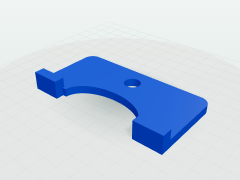
 Drawer Finger-Pull Scoop (80 mm) — Router corner & template jig 3D print model
Design 3D-printable woodworking router templates: 4-in-1 radius quads, fenced corner jigs, 45° chamfers, cove corners, drawer finger pulls and handle slots.
Features
- Six woodworking router templates in one generator: 4-in-1 radius quad, single fenced radius, 45° corner chamfer, concave cove corner, drawer finger-pull scoop and recessed handle slot
- Built-in registration fence lip with inner corner sawdust-relief notch so square stock seats dead-true
- Automatic guide-bushing offset compensation (0 mm for flush-trim bearing bits, or custom offset for guide bushings)
- Prints flat upside-down on z = 0 with zero supports required and a smooth top bearing track
- Optional clamping/hanging hole and embossed corner sizing readouts
What people make with it
- Rout repeatable round corners (R5 to R60) on tables, cutting boards and shelves with a flush-trim bit
- Print a compact 4-in-1 radius quad plate (e.g. R10/R15/R20/R25) for everyday shop work
- Cut crisp 45° corner chamfers or decorative concave cove corners without resetting a table fence
- Rout clean semicircular finger pulls on handleless cabinet doors and drawers
- Cut centered stadium carrying-handle slots in serving trays or desk cable pass-throughs
How to use
- Choose a template type (4-in-1 quad, single fenced radius, chamfer, cove, finger pull or handle slot).
- Set your target radius or cutout dimensions and verify guide-bushing offset (0 mm for flush-trim bearing bits).
- Print in PETG, ASA or ABS with 4–5 wall loops and 30–40% gyroid infill for heat and clamp rigidity.
- Lightly sand the bearing edge smooth, seat the registration fence firmly against your workpiece, and clamp securely.
- Make light climb-free passes with a flush-trim or pattern router bit.
Materials
- PETG: recommended
- ASA: recommended
- ABS: works
- PLA: fit check only — Can soften under hot router bearings.
Presets
Frequently asked questions
Which filament should I print router jigs in?
PETG, ASA or ABS with 4–5 walls and 30–40% infill. Standard PLA works for light occasional use, but a hot router bearing can soften PLA on long passes.
Why does the jig print upside-down?
With the flat template plate on the build plate (z = 0) and the registration fence pointing up, the entire jig prints 100% support-free with a dead-flat reference face.
How do I use a brass guide bushing instead of a flush-trim bearing?
Set Guide bushing offset to (bushing OD − bit diameter) / 2. For example, a 16 mm bushing with a 12 mm bit needs a 2.0 mm offset.
Related generators
For AI agents and developers: API v1, schema.json, index.md. Open-source licences