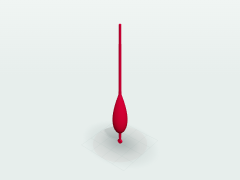
 Pašizsvarojošs vāglers — 3+2 g — Pludiņu ģenerators 3D print model
Izveido 3D drukājamus makšķerēšanas pludiņus ar reālu Arhimēda peldspējas, ūdenslīnijas, stabilitātes un bezsvina atsvaru aprēķinu.
Iespējas
- Eight classic and experimental body profiles: teardrop, inverted teardrop, pencil quill, bodied waggler, pike bulb, flat river disc, hydro-ribbed anti-roll and finned flighted dart
- Four rigging styles: classic keel & eye, bottom-eye waggler, center through-bore inline, and sliding predator rig
- Four antenna tips: thin hi-vis bristle, lift-bite sight bulb, 4.5 mm night glow-stick socket, and 3-vane flighted dart
- Real Archimedes buoyancy engine: computes displacement, plastic + epoxy mass, shotting capacity (e.g. 3+2 g), bite sensitivity (mm per 0.1 g) and metacentric stability (GM)
- Supports ultra-light LW-PLA (0.65 g/cm³), PETG, PLA and ASA with slicer wall/infill mass modeling
- 100% lead-free self-cocking internal ballast pocket (steel, stainless, brass or tungsten balls)
What people make with it
- Design custom stillwater, Bolognese, waggler, inline carp and predator floats sized to exact gram ratings
- Experiment with hydrodynamic shapes like flat river discs, anti-roll hydro-ribbed bodies and finned flighted darts
- Calculate exact remaining shotting capacity, waterline height, bite sensitivity and righting stability before printing
- Build self-cocking wagglers with sealed lead-free steel, brass or tungsten BBs
- Fit standard 4.5 mm chemical glow sticks for night fishing
Kā lietot
- Pick a classic or experimental float preset (teardrop, waggler, river disc, inline carp, night glow-stick or predator bulb).
- Adjust body length, diameter, antenna tip and internal pre-weight while checking the live shotting capacity and stability readout.
- Select LW-PLA (best lift) or PETG/PLA and match your slicer wall count and infill %.
- Print upright (with brim) or insert lead-free ballast BBs at the print pause, then seal with a thin waterproof epoxy or varnish coat.
- Attach to your mainline, add split shot until the waterline sits at the base of the antenna, and fish.
Materials
- LW-PLA: recommended
- PETG: works
- PLA: works
- ASA: works
Sākotnējie varianti
Biežākie jautājumi
What filament works best for 3D-printed floats?
Active-foaming LW-PLA (0.65 g/cm³) gives the highest buoyancy, closest to balsa wood. Standard PLA or PETG with 1–2 walls and 5–10% gyroid infill also floats well for medium and heavy floats.
Do 3D-printed floats need waterproofing?
Yes. FDM layer lines can slowly absorb water over long sessions. Brush on one thin coat of 2-part epoxy, clear nail varnish, or acrylic lacquer to seal the shell completely.
How is the shotting capacity calculated?
From the exact 3D mesh volume using Archimedes' principle: total displacement minus estimated plastic mass, waterproof coating mass, and any internal self-cocking ballast.
Why does stability (GM) matter?
A float must have its center of gravity below its metacenter (GM > 0) to stand upright immediately on the cast. Adding a longer keel, internal lower ballast, or line shot lowers CG and makes the float self-righting.
Related generators
For AI agents and developers: API v1, schema.json, index.md. Atvērtā koda licences